Stochastic Optimizers
About
The d9d.optim.stochastic module provides optimizers for training with bf16 parameters and no fp32 master copy. They round the updated parameters to bf16 with stochastic rounding. The update and the rounding run in one fused Triton kernel. The kernels live in d9d.kernel.stochastic and can also be called directly.
Stochastic Rounding
A standard cast such as tensor.to(torch.bfloat16) rounds to the nearest representable value. In bf16 training this can stall learning. If an update is smaller than half the gap between two bf16 values, rounding removes it completely.
Stochastic rounding rounds up or down at random. For example, if a value \(x\) is \(30\%\) of the way from representable value \(A\) to representable value \(B\), it rounds to \(B\) with \(30\%\) probability and to \(A\) with \(70\%\) probability. The expected result equals the exact value, \(E[Round(x)] = x\). Small updates therefore add up over many steps instead of being lost.
For details, see:
- Zamirai, Pedram, et al. “Revisiting BFloat16 Training.” Version 2
- Ozkara, Kaan, et al. “Stochastic Rounding for LLM Training: Theory and Practice.”
Limits
- The kernels need a GPU that runs Triton.
StochasticAdamWparameters must be bf16. Gradients can be bf16 or fp32. Optimizer states can be fp32 or bf16 (state_dtype).StochasticAdamWdoes not support closures or sparse gradients.
Usage
StochasticAdamW saves the state of its random number generator in state_dict(). A resumed run gets the same rounding noise.
Benchmarks
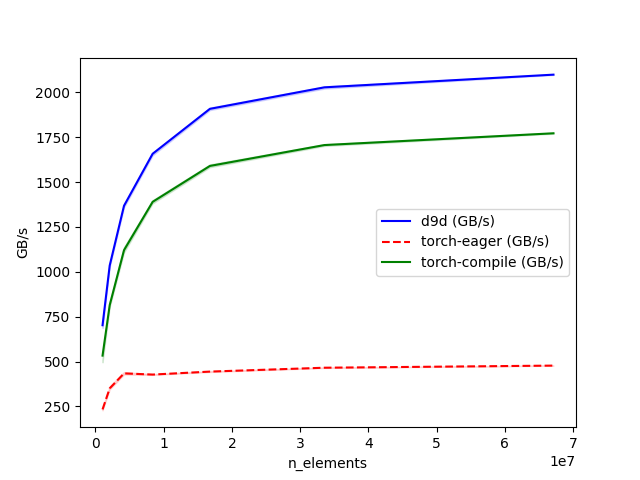
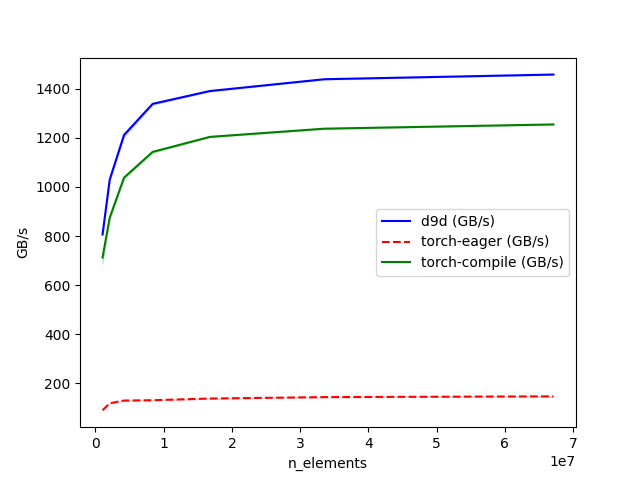
The plots show throughput in GB/s against the number of elements. The baselines are a PyTorch eager and a torch.compile implementation of the same operation.
copy_fp32_to_bf16_stochastic_ (H100 80GB, fp32 source, bf16 target)
adamw_stochastic_bf16_ (H100 80GB, bf16 parameters, gradients and states)
API Reference
d9d.optim.stochastic
Optimizers that update bf16 parameters with stochastic rounding.
StochasticAdamW
Bases: Optimizer
AdamW optimizer for bf16 parameters with stochastic rounding.
Parameters must be bf16. Gradients can be bf16 or fp32. Parameters can be DTensors.
The optimizer owns its random number generator and saves the generator state in state_dict. A
resumed run therefore gets the same rounding noise.
__init__(params, lr, betas=(0.9, 0.999), eps=1e-08, weight_decay=0.01, generator=None, state_dtype=torch.float32)
Constructs the StochasticAdamW object.
Parameters:
| Name | Type | Description | Default |
|---|---|---|---|
params
|
ParamsT
|
Parameters to optimize, or dicts that define parameter groups. |
required |
lr
|
float
|
Learning rate. |
required |
betas
|
tuple[float, float]
|
Decay rates of the first and second moments. |
(0.9, 0.999)
|
eps
|
float
|
Term added to the denominator for numerical stability. |
1e-08
|
weight_decay
|
float
|
Decoupled weight decay coefficient. |
0.01
|
generator
|
Generator | None
|
Random number generator for stochastic rounding. If |
None
|
state_dtype
|
dtype
|
Dtype of the optimizer states. Can be |
float32
|
Raises:
| Type | Description |
|---|---|
ValueError
|
If |
load_state_dict(state_dict)
Loads the optimizer state, including the generator state if it is present.
state_dict()
Returns the optimizer state, including the generator state.
d9d.kernel.stochastic
Triton kernels that round fp32 values to bf16 stochastically.
adamw_stochastic_bf16_(params, grads, exp_avg, exp_avg_sq, lr, beta1, beta2, eps, weight_decay, step, generator=None)
Performs one in-place AdamW step on bf16 parameters with stochastic rounding.
The update is computed in fp32, and the new parameters are rounded to bf16 stochastically. Gradients and optimizer states can be fp32 or bf16. States stored in bf16 are also rounded stochastically.
Parameters:
| Name | Type | Description | Default |
|---|---|---|---|
params
|
Tensor
|
Parameters to update in place. Must be bf16 and contiguous. |
required |
grads
|
Tensor
|
Gradients, in bf16 or fp32. |
required |
exp_avg
|
Tensor
|
First moment (moving average of the gradients), updated in place. Must be contiguous. |
required |
exp_avg_sq
|
Tensor
|
Second moment (moving average of the squared gradients), updated in place. Must be
contiguous and have the same dtype as |
required |
lr
|
float
|
Learning rate. |
required |
beta1
|
float
|
Decay rate of the first moment. |
required |
beta2
|
float
|
Decay rate of the second moment. |
required |
eps
|
float
|
Term added to the denominator for numerical stability. |
required |
weight_decay
|
float
|
Decoupled weight decay coefficient. |
required |
step
|
int
|
Number of the current step, used for bias correction. Must be at least 1. |
required |
generator
|
Generator | None
|
Random number generator that seeds the stochastic rounding. If |
None
|
Raises:
| Type | Description |
|---|---|
ValueError
|
If |
copy_fp32_to_bf16_stochastic_(target, source, generator=None)
Copies an fp32 tensor into a bf16 tensor in place with stochastic rounding.
Stochastic rounding rounds each value up or down at random. The probability of rounding up equals the
fraction that the cast drops, so the expected value is preserved: E[round(x)] = x. Small updates
then accumulate in bf16 instead of being lost.
Parameters:
| Name | Type | Description | Default |
|---|---|---|---|
target
|
Tensor
|
Output tensor. Must be bf16 and contiguous. |
required |
source
|
Tensor
|
Input tensor. Must be fp32 and have the same shape as |
required |
generator
|
Generator | None
|
Random number generator that seeds the rounding noise. If |
None
|
Returns:
| Type | Description |
|---|---|
Tensor
|
The |
Raises:
| Type | Description |
|---|---|
ValueError
|
If |